Shooting, as a sport or hobby, has some rare compensations. At the minimum, it’s a complex manual skill that is a simultaneous joy and challenge to acquire. It also affords many intermediate satisfactions and variations. No wonder then, that it proves such a durable interest for many, spanning not merely lifetimes but generations in countless American families.
That it can also save lives and preserve order is misunderstood—often deliberately—in modern times. The mere presence of a firearm thwarts many unsocial escalations—take a look at “Armed Citizen” if you doubt this. And here is where it parts company with most other hobbies and sports: Not to put too fine a point on it, but we could find not a single reference to criminal undertakings or other unrest being undone by a minus-20-degree goose down bag or carbon fiber mountain bike, however excellent or well-employed.
This intersection between sporting utility and unwelcome necessity is where many shooters risk coming up short. The habits and practices of one mindset don’t always forward the goals of the other. If this remains obscure, think of it this way: It’s the difference between making an excellent shot when you wish, versus a satisfactory shot when you must. This intersection between sporting utility and unwelcome necessity is where many shooters risk coming up short. The habits and practices of one mindset don’t always forward the goals of the other.
These are more different than you might expect, and there’s little consequence for getting the first sort wrong. The second is a completely different story. We suggest that a practical, inexpensive key to sorting this out is to train with a shot timer.
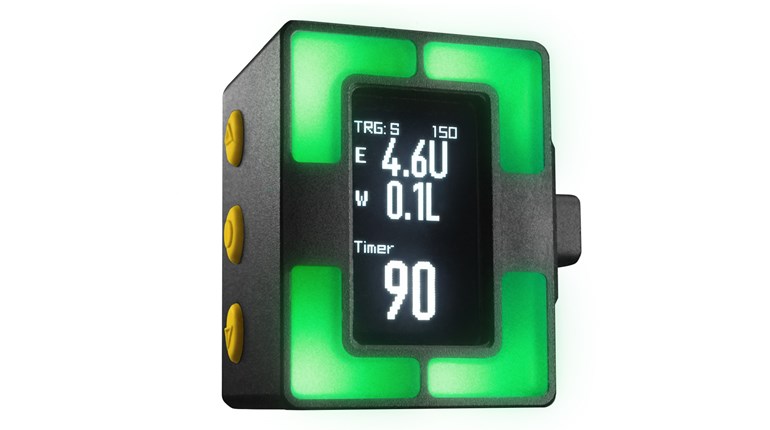
These are conceptually simple gadgets, really; a digital stopwatch attached to a microphone. They are designed to provide a start signal and “listen” to your shots. Where they get clever is the ability to record the times of a string of shots, and then let you review those times—generally called splits—and analyze the variation(s).
For competitive shooting, the utility is obvious: Scoring is based on some mathematical relationship between the time it takes to make the shots in a prescribed course of fire and their quality/accuracy, plus or minus any penalties (some disciplines count generally up to determine score, others count down). Built into this process is the notion of a randomized start, generally between one and four seconds. A live range officer generally handles this in competition, but a shot timer will do it for you during training.
It’s easy to underestimate the value of randomized starts. In a defensive scenario—and aside from moral considerations—there are two crucial break points. First is the decision that action is necessary. This must proceed from situational awareness, and an untimed “self-start” has no way to proxy this real-world processing interval. While it’s variable, certainly, such an interval won’t be long.
Second—and where a timer comes into play—is that most everyone overestimates how quickly they can get their defensive firearm into action. Nothing demonstrates deficiencies here quite like a timer: Buzz to bang is arguably the most crucial test of true defensive preparedness. A good quality (“A” hit on an IPSC target) from cover carry can easily take 2-plus seconds; from open carry, a second-and-half is respectable. Or, trans-warp here: Rob Leatham. (We watched Rob do this actual demo … er, wow?) The point is simple: A subjective notion of speed and what it lets us think are “safe” distances is deeply counterproductive as a Tueller or similar drill plainly shows.
The second function of shot timers is similarly useful. The measurement of elapsed time between shots can teach a lot, too. Though we know he wouldn’t claim them as original to him, we never think of this capacity without the words of über-master instructor John Farnum (Defense Training International) ringing in our ears: “Don’t shoot faster than you can hit.” But as John also says, “If you don’t train with a timer, you’ll never know how fast that is.”
Measuring the times between shots is helpful in three ways. True “splits”—the time between shots on the same target—clock how rapidly you can complete the cycle of a single mechanically correct and accurately placed shot. It assumes the firearm is presented and gripped, and a shot initiated. Beginning with the report of that shot, it captures the interval of tracking the sights through recoil and recovery up to delivery of a subsequent shot.
If you watch this (astonishing) Max Michel video, you’ll have a good look at the second and third benefits of interval measurement, too: transitions, and in this case, with a reload. The second is the time it takes to move between targets: recovering the pistol from a shot and moving on to a new target. This interval is generally longer than a true split as the process is more complex, but properly done, not by much.
The third interval demonstrates a dazzling reload pace, too—well under a second, shot-to-shot.
As you see, all these things can be baselined and practiced only with a timer. While our examples are from competition venues, training with a timer is no less valid, for instance, on your concealed draw and reload. Also consider that fundamentals are just the beginning: As long as dimensions and distances of your courses of fire remain the same, virtually any target array can become a yardstick for improvement.As you see, all these things can be baselined and practiced only with a timer.
In terms of hardware, there are many good choices: CED 8000 is one we’ve used a lot. It has numerous sensitivity adjustments that allow you to tune out the wind for instance (by setting the mic level), but will still pick up rimfire. Sensitive enough to hear dry-fire hammer-fall if properly positioned, it’s otherwise dizzyingly complete, with multiple par- and competitive timing modes.
If ultra-compact is the name of the game, the ShotMaxx is a largish wristwatch. No pun intended, but … handy?
Two long-time favorites (and maybe the best place to start) are the amazingly rugged Pocket Pro or Pact “club” timers. We hate to tell you how many times we’ve dropped ours, yet they just keep on humming.
One caveat if you move ahead with timing your training: Using a timer can get you into the mindset of completing every action with a shot. While this is a reasoned expectation for range work and especially for competition, it should not become your default for concealed-carry skills development.
Really knowing what you’re doing, and the ability to do it with precision and confidence, can diffuse a dangerous circumstance rapidly without force: We’ve been there.
But the overarching goal should always be situational awareness toggled fully “ON,” and a shooting situation avoided altogether.