Though only shooting will tell for sure, our build is going well. The shooting part is getting appreciably closer, too, as this week we add the gas system to our short/light rifle.
Right out of the chute, we offer a proviso: Gas systems are a good way to start a fistfight. There are lots of opinions about what is optimum, and the underlying reasons for choices are both serpentine and interrelated. That’s not a dodge: The truth is that “correct” is a continuum in this case, not “my way or the highway.”
At least tied for the biggest divider is piston vs. the original “direct impingement” drive system for the Stoner-pattern rifles. We won’t drag you through (another) blow-by-blow. Our build is following the original, where propulsive gas/pressure is harvested as each bullet passes a bleed port in the barrel, and fed back to the action through the gas key on the BCG to unlock the bolt lugs, pull the spent case onto the ejector for expulsion, and charge the buffer system with loading energy for a subsequent shot.
Detractors correctly say it puts carbon and heat where it doesn’t ideally belong, and offer a short-stroke piston (a la the AK or FAL) as the perfect solution. Here, the harvested pressure vents against what amounts to a drive shaft that runs the action, and no heat or fouling reach the action through the mechanism. What they don’t like to focus on is added weight, and moving weight to boot, in an area of the rifle where it doesn’t exactly help with controllability or accuracy.
We’d argue that these rationales matter only at the far margins for the vast majority of shooters and shooting. DI (the original) systems do seem to yield better results—slightly better accuracy and a subtle “smoothness”—on longer barrel (and gas system) lengths, but there’s no question that shorter systems, especially when suppressed, are better off as piston rigs. But are piston systems inaccurate? Try sliding that one by the Adams Arms folks: We’ll be nodding in their defense when they tell you to go fish. And our BCG choice has kept more than one gas gun running (and running, and running) while hideously filthy.
So we’re picking direct impingement to save weight, and because our barrel length is in the range where accuracy seems to slightly favor the original design (16 inches and longer, and ours is 18).
Another wrangle centers around whether your gas system needs to be adjustable or not. A lot of shooters are trending “for” adjustability, with, er, visions of 20dB noise reductions if the Hearing Protection Act passes and suppressors get out of Class III jail. If so, adjustability may be worth the two- to four-times cost multiplier. These blocks can add minor weight too, due to slightly greater complexity, but this doesn’t drive our choice.
What does drive our choice is that anything that is adjustable can get out of adjustment too, and we’ve seen malfunctioning adjustability stop rifles. Plus, most suppressors add meaningful length and weight to non-SBRs—six inches or more—and our goal is light and short. Recognizing we may need to change eventually, we’re going simple …
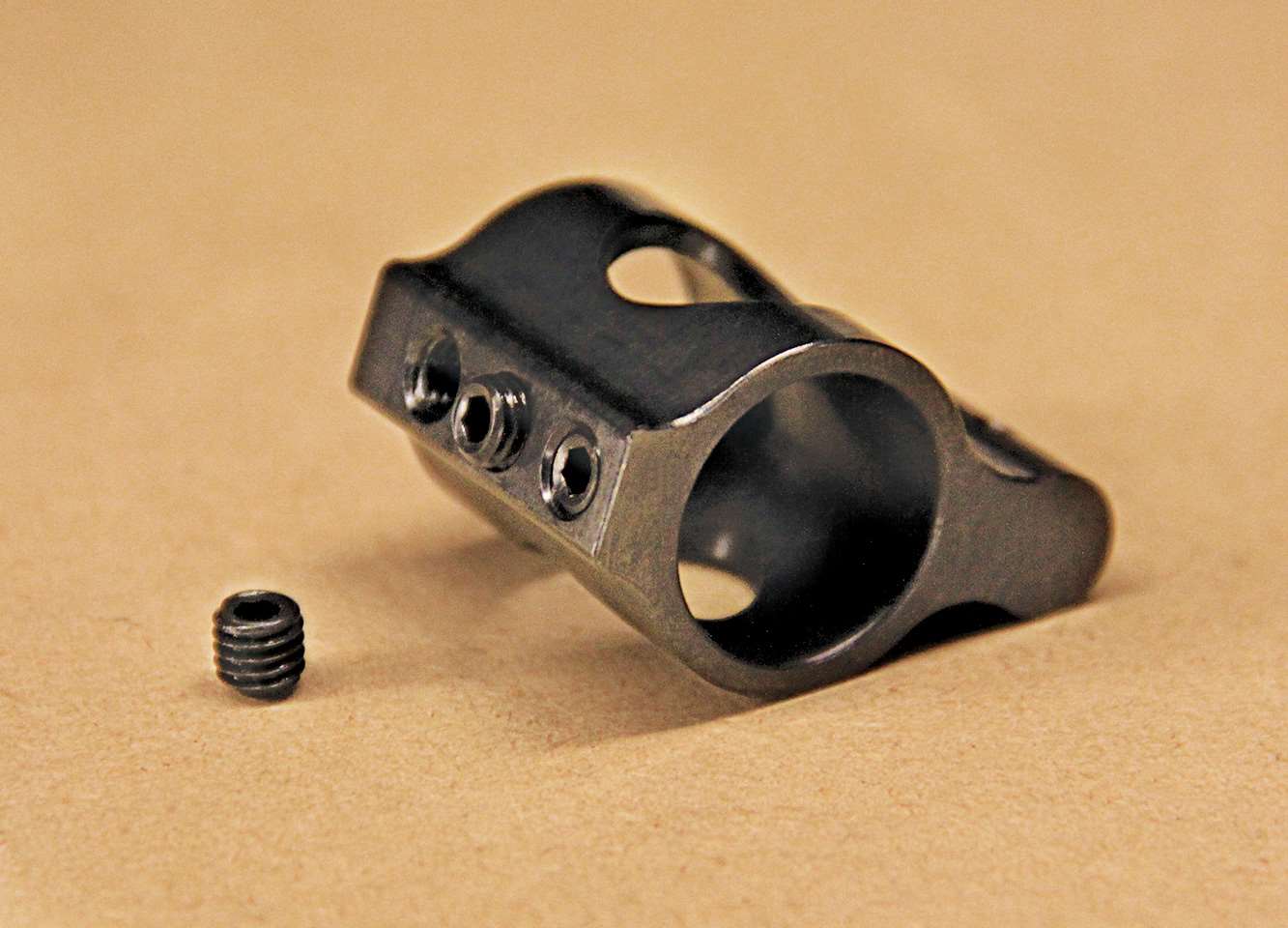
… and very light. The last bone of contention in choosing a gas block is retention method, of which there are three. Less common now, the original used tapered pins; we can’t recall the last time we saw these anywhere but a combined, A2-style sight tower/gas block. Far more common are setscrew types: Either two or three screws tension against the bottom of the barrel opposite the gas port. These aren’t as tough to install as you might think, but follow instructions carefully (a great set here from our friend Bob Boyd at Shooting Illustrated)—it’s possible to over-tension the setscrews enough to deform the interior barrel wall. While it’s debatable that such a barrel is entirely ruined, it certainly will never shoot with a rifle without such a deficit. We went with this type, in particular a diminutive Faxon via Brownells.
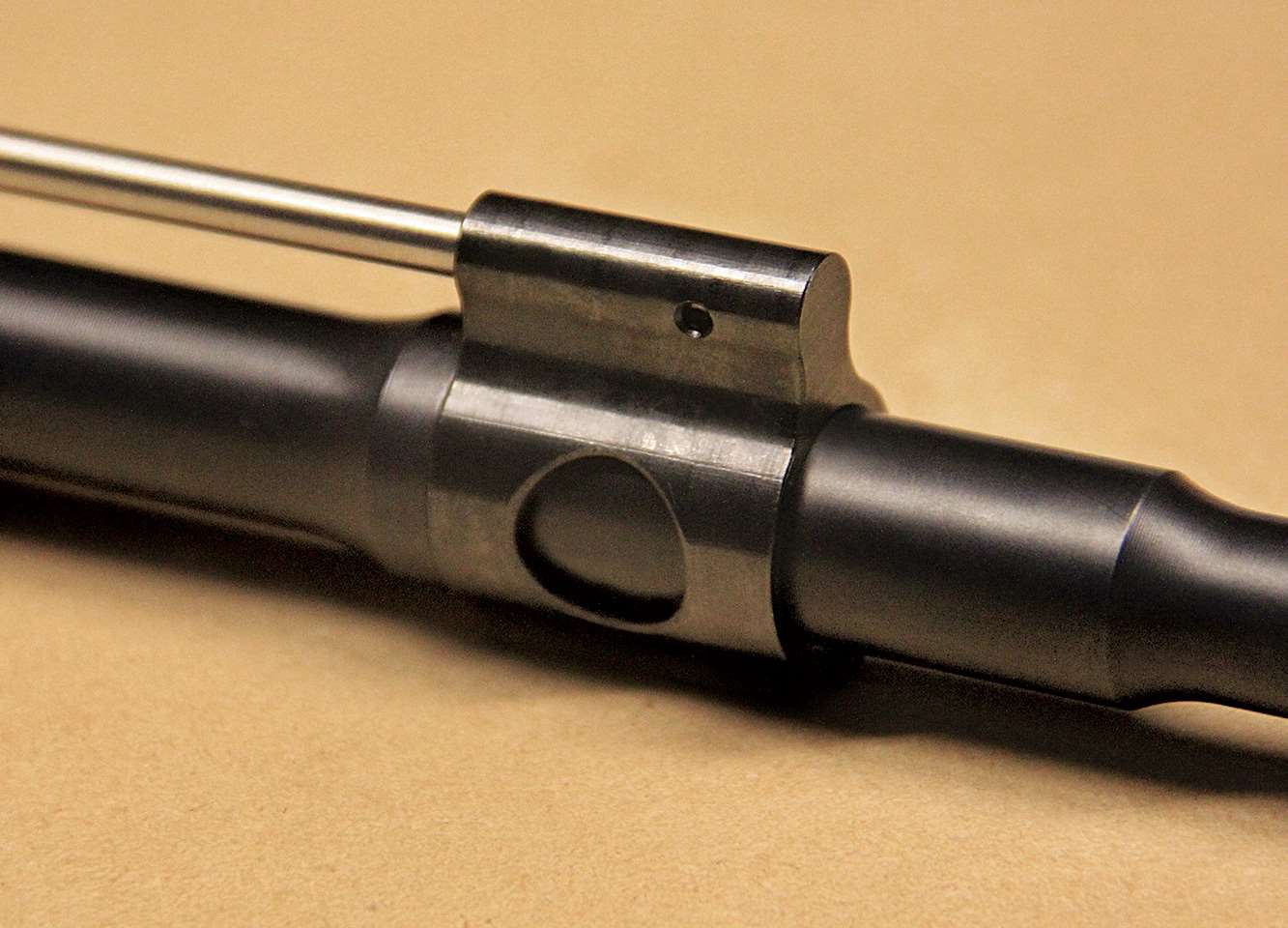
The last are clamp type. We didn’t avoid them for any particular reason—in fact, some folks argue they’re better in terms of how they apply retention pressure, as well as easier to install. On the latter, point taken, but on the former we’re not sure we buy this altogether. Clamps remain solely friction fit, albeit a tight one. If you dimple beneath the setscrew type as recommended in our link above, you’ll have a mechanical as well as a pressure “stop,” multiplied by the number of setscrews. The friction fit idea is working on gobs of surface area, however, and that’s a good thing; though if it does let go, well …
Two last points. Nearly all install regimens recommend Loctite or some threadlocker, and we concur. Where we depart is in the strength of the compound. You don’t go long in shooting MSR/AR rifles without noting that the gas block heats up, and big time after long strings. The usually-recommended 242 “Blue” may not prove up to the task, softening as it does above 300 degrees. Sparingly applied as always, “Red” (Loctite 271) doesn’t have the same temperature limits, and will get you to around 450 degrees before loosening. It’s important here to know your own limitations in terms of both tools and willingness. Otherwise, “Blue” will have to do.
Finally, don’t let the joy of DIY get the better of good sense. A factor in the assembly of the other end of the gas system, i.e. where the gas tube goes into the upper receiver is rarely discussed, but can become a surprisingly thorny wear issue as well as having a negative effect on accuracy. This occurs when the gas key comes in contact with the tube itself. Suffice it to say, a no-no? Our go-to gunsmith Gary Kimball says getting the whole upper fitted properly to avoid this runs between $75 and $100, depending on the handguard.
That’s cheap insurance, we’d say.
Part 1 Part 2 Part 3 Part 4 Part 5 Part 6 Part 7 Part 8