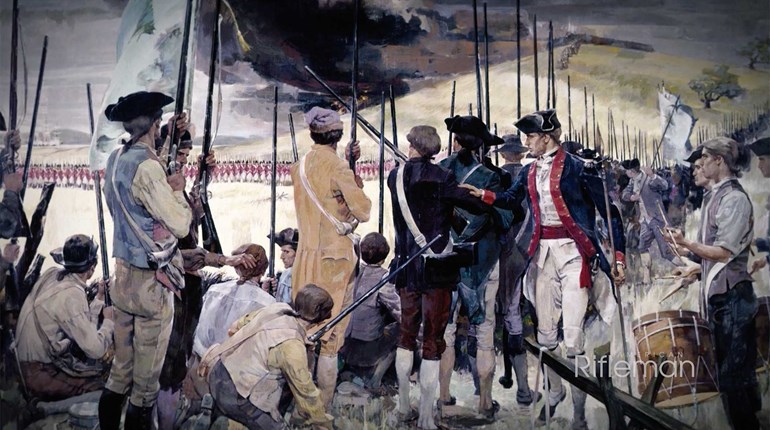
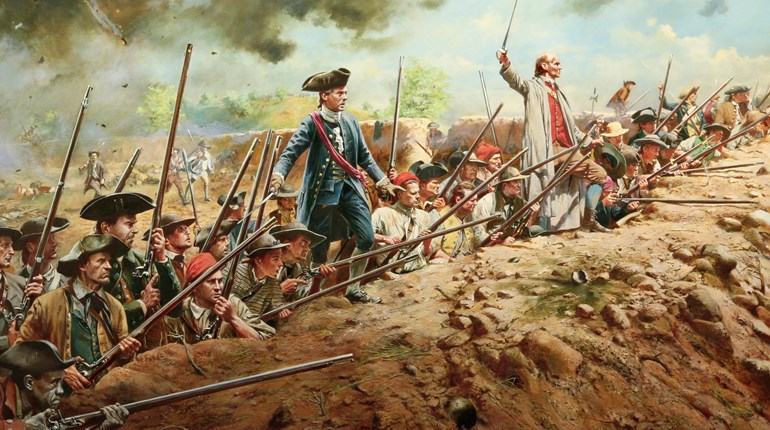
Emanuel Leutze’s 1851 oil of George Washington crossing the ice-choked Delaware with his ragged-but-determined troops is perhaps the pre-eminent image of the Revolutionary War. Irregularly drawn from the reaches of 13 squabbling colonies and at no time numbering more than 17,000, those soldiers would nevertheless harry, exhaust and connive their way to an almost inconceivable victory. As historians David and Jeanne Heidler said, “The British never had the slightest doubt that they would quash the rebellious American rabble led by a Virginia farmer.”

But if the odds were long for the Continental Army, they were astronomical for the Continental Navy. Formed in October of 1775—like the Army, technically before the United States was a nation at all—the Navy faced a nautical titan in the Royal Navy: 131 ships of the line, nearly equal to the total of all similar vessels in the rest of the world’s combined navies at the time. Though depleted somewhat in the course of the the Seven Years’ War, or French and Indian War, with France, it dwarfed the individual Colonial fleets that were eventually combined as a “national” navy. In any case, none of the vessels remotely matched the likes of the 50-gun HMS Leopard, 54-gun HMS Antelope, or 74-gun HMS Fame or Invincible.
Still, the new Navy had important allies. Both George Washington and John Adams saw the need for interdiction of British shipping, and set about acquiring or building the needed vessels. Washington, in fact, acquired the Navy’s first vessel out of his own pocket—the schooner Hannah. While the Hannah’s career was short, she ferried eventual ambassador Benjamin Franklin to enlist French help in the war and captured the British sloop HMS Unity. By December of 1775, the Continental Congress had commissioned 13 frigates.
Other limited successes followed, including Benedict Arnold’s delaying action against the British on Lake Champlain, and Commodore John Paul Jones’ defeat of the HMS Serapis aboard Bonhomme Richard in the Battle of Flamborough Head.Time may have “gotten by,” but not the traditions and excellence that began the U.S. Navy even before the strokes of those 56 pens made us a nation.
In the final analysis, much of the Continental Navy’s effectiveness during the Revolution was like that of General Washington’s land troops: Through constant harassment and repeated disruption, the far larger, far more experienced foe was simply exhausted. Like the Continental Army, the Navy was disbanded: Most of her ships had been destroyed, and those salvageable were sold by 1785.
Not lost, however, was the tradition of service and first-rate seamanship. When former ally France began to seize American vessels in the late 1790s (300 by 1797), the newly inaugurated second president and ardent supporter of the Continental Navy John Adams began to rebuild U.S. naval forces. In the next 20 years, the Navy gained a reputation through the exploits of the USS Constitution and USS Intrepid that has never been relinquished.
Need and funding had driven the waxing and waning of the fleet through nearly a century—much as it did with the U.S. Army—but by 1920, the United States possessed the world’s most powerful navy. Even the surprise assault by the Empire of Japan at Pearl Harbor in December 1941 represented only a setback: Having pioneered naval airpower, U.S. carriers determined the course of the Pacific War (WWII) with key victories against daunting odds at the Battle of the Coral Sea and Midway. Their counterparts in the Atlantic fought back Hitler’s U-boats and supplied Great Britain through the North Atlantic. In the Cold War, Admiral Hyman Rickover’s nuclear submarines formed the all-but-invisible third leg of the nuclear deterrence.
The Navy of today consists of more than 400,000 active and reserve personnel, 3,600-plus aircraft and 271 vessels of all types (a fascinating chart here). A review of that chart is at least thought-provoking, as the modern obsession with the moment is uncharted in these waters: An entire class of ships bears the names of Oliver Hazard Perry and Ticonderoga, and individual vessels still have names like Bonhomme Richard, Bunker Hill, Cowpens, George Washington and Princeton. “Old Ironsides” (the 44-gun heavy frigate USS Constitution of 1797) remains afloat, and a commissioned ship—the oldest in the world, by far.
Time may have “gotten by,” but not the traditions and excellence that began the U.S. Navy even before the strokes of those 56 pens made us a nation.