We often use Hollywood as a pejorative in these pages. Many film executives have been asking for this treatment.
It is, after all, one thing to ignore the anti-Second Amendment politics of an actor who stars in shoot-‘em-up action films, but it is quite another to shrug away anti-gun political messaging fronting as moral goodness in a TV drama or film.
Nevertheless, we do.
We shake our heads and sigh when our national storytellers aren’t just peddling weak falsehoods about America’s more than 100 million gun owners but also are so intellectually lazy or so immersed in their anti-gun bubbles that they get basic things about guns and the laws that regulate them wrong.
Admittedly, there can be a tinge of cathartic pleasure in voicing honest criticisms of Hollywood actors, writers and producers who ignorantly attack this right—this is very much like when an audience cheers after President Donald Trump (R) points to the back of a rally and calls the “journalists” standing there behind their cameras and microphones “fake news.”
Still, those are only the obvious things to say about the complex relationship between America’s millions and millions of lawfully armed citizens and the juggernaut we refer to as Hollywood.
A deeper point can be made that Hollywood, even today, is not quite a monolith of propagandistic power moving against our Second Amendment rights. Taylor Sheridan’s many projects have been very honest about American gun culture. Keanu Reeves’ character “John Wick” is hardly anti-gun. Actor Dean Cain is so pro-freedom that he has now brought us a very pro-Second Amendment film from JCFilms Studios (see, Heels to Holster, p. 28).
There are many other contemporary examples; in fact, it might be surprising to say this plainly, but, since the beginning of film, Hollywood has been asking if guns are necessary to freedom, and, despite all their faux virtue signaling, film studios have mostly answered this question with a reluctant but steady, “Hell, yes!”
This is because the fact that guns are equalizers that empower the weak is so true it is unstoppable. A hero who is so ideologically opposed to our freedom that he will not pick up a gun to fight armed bad guys is so unrealistic, stupid and dishonest that such a film would be a parody at best. To be interesting and to have a fighting chance, heroes need to be creative and, to some extent, honest. This means they need modern tools, such as those protected by the Second Amendment. Hollywood can’t just make rom-coms; they can’t abandon the hero with the gun in Westerns, police dramas, war films, action-adventure films, sci-fi flicks and more, because if they did, some other studio, in a daring move to make a profit, would make these films to please America’s large and diverse audience.
Since The Great Train Robbery, a 1903 silent film—silent, it pounded along on the beat of a Western barroom piano—showed what a smashing success these films are with the public, Hollywood has been subject to a force as persistent and strong as gravity—to what Joseph Campbell tagged the “hero’s journey.” This force is the compelling need for good armed citizens to fight back against lawlessness and evil. (Incidentally, The Great Train Robbery ends with a posse of good guys with guns shooting down the murderous robbers.)
This insatiable need for armed justice is part of the reason why, when films get guns right—or at least don’t push politics too much into the plots—we cheer. Guns are critical tools for our heroes and for us.
To celebrate this part of the relationship with cinema, the NRA National Firearms Museum in Fairfax, Va., has a “Hollywood Guns” section. Here are a few of the guns found in this museum, along with elements of the story they tell about American film and about our freedom.
Hollywood Often Exempts the Flintlock
The settlers that gave America “manifest destiny” didn’t talk about guns as good or evil things, but as tools that could be used for good or ill. Until the early 20th century, guns were mostly treated as mechanical instruments needed to subdue wild animals and outlaws (a role that still matters in many places). Hollywood has mostly exempted these period films from their incessant politics.
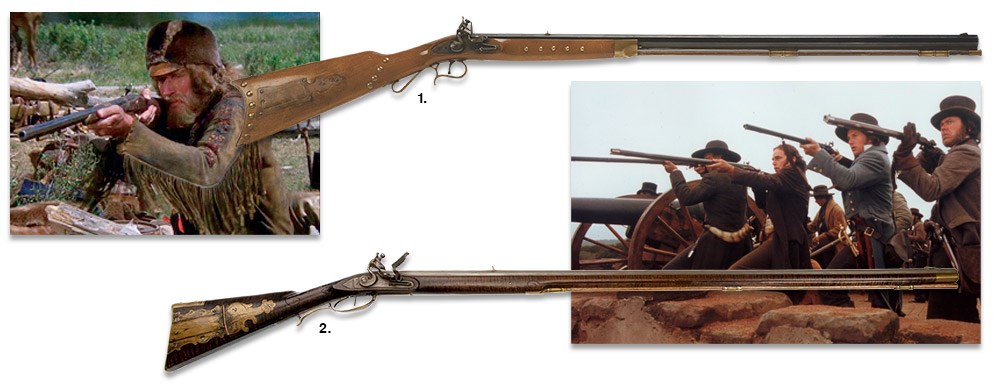
The N R A National Firearms Museum showcases many firearms from before the invention of the self-contained cartridge; in the Hollywood Guns collection are firearms such as 1. the .45-cal. Italian Plains Rifle carried by Charlton Heston as Bill Tyler in The Mountain Men (1980) and 2. the .56-cal. American Custom Longrifle that actor Billy Bob Thorton carried when he played Davy Crockett in The Alamo (2004).
Hollywood’s Ardor for Gun Technology
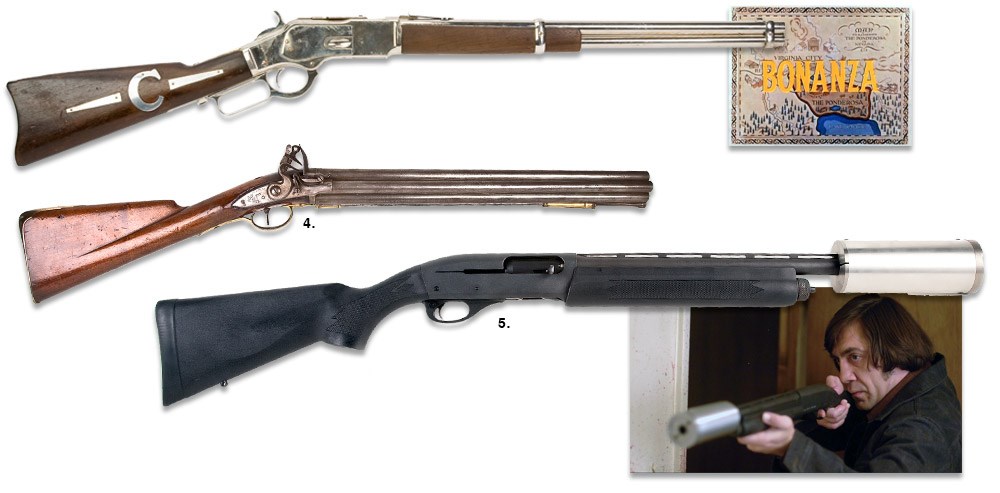
Hollywood studios can often be anti-gun, but they sure love showcasing cool, new gun technology. Jimmy Stewart in Winchester ‘73 (1950) is a classic example of such a role. A Winchester ‘73 (this one from the show Bonanza) 3. is in the N R A National Firearms Museum.
Even the 1960 version of The Alamo showed Richard Widmark, as Jim Bowie, with 4. a Nock Volley Gun, a .52-cal., seven-barreled smoothbore wonder of new gun tech.
Another example most of us will recognize is 5. the 12-gauge Remington 11-87 shotgun in No Country for Old Men (2007). The villain, played by Javier Bardem, had his semi-automatic shotgun suppressed in this Coen Brothers classic.
The Cowboy’s Guns
Even the classic period of Hollywood cinema was peppered with Westerns that questioned the citizens’ need for guns—usually after a hero used a gun to stop bad guys. This even included John Wayne classics like The Angel and the Badman (1947) and The Shootist (1976). Such films were not anti-gun, but they toyed with the theme that gun ownership attracts trouble. The Fastest Gun Alive (1959), starring Glenn Ford, even made the claim, as other films did, that only a person who carries a gun needs a gun. This claim was almost always refuted by the actual plots of the stories told, but still, there it was, lying in the open like a politician’s unchallenged lie.
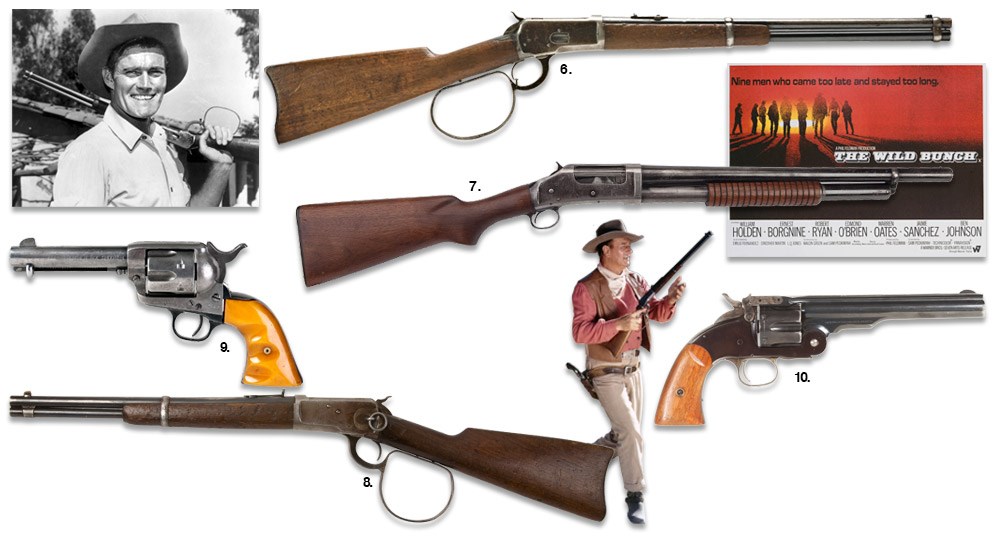
Nevertheless, in most of these films, good guys need guns to fight the bad guys—or just to kill a rattlesnake. The Rifleman (1958-1963), which starred a former baseball player named Chuck Connors as Lucas McCain, showcased 6. a very cool Winchester 1892 in .44-40 Win. In the opening sequence, Connors fires 12 shots incredibly fast, thanks to his skill and to a set-screw modification in the lever designed by the fast-draw artist Rodd Redwing.
Also in the N R A National Firearms Museum are guns from The Wild Bunch (1969), such as 7. a Winchester Model 1897 12-guage shotgun carried by Ernest Borgnine. John Wayne has quite a few here as well, including 8. a large-loop-lever Winchester Model 1892 in .44-40 Win. that he used in Hondo (1953) and Big Jake (1971).
There are also six-shooters. These include 9. a Colt Frontier revolver in .44-40 that Wayne carried in Rio Lobo (1970) and a 10. Cimarron Schofield Model 3 in .45 cal. showcased in the 2007 version of 3:10 to Yuma.
20th Century War Films
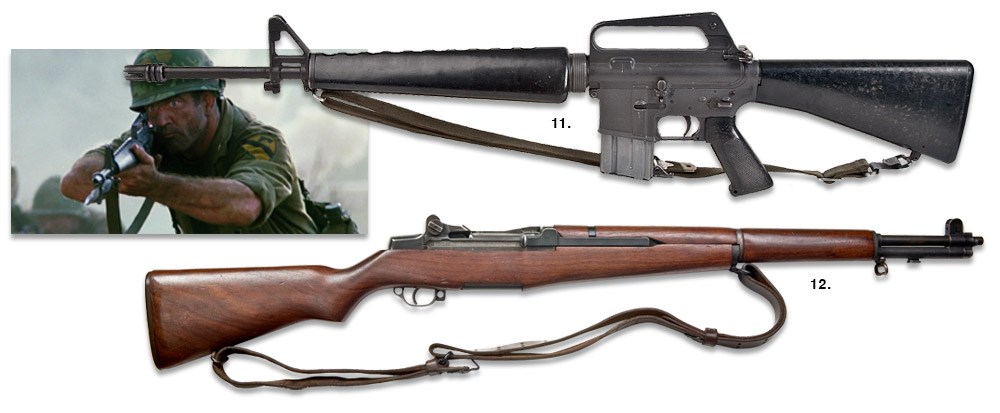
Now we get to what many in Hollywood would call “assault weapons.” In the military arms shown, such as 11. the full-auto Colt M16 in 5.56 mm N A T O used in We Were Soldiers (2002), starring Mel Gibson, the term could be reasonably applied. More often, in today’s Hollywood, the bad guys have popular A R-type rifles, whereas if the good guys are armed, they have something old and maybe rusty.
Still, there are many variations on this theme. Clint Eastwood as Walt Kowalski in Gran Torino (2008), for example, protects himself with 12. his M1 Garand in .30-06. (Yes, this is in the museum, too.)
Cops, Robbers and Armed Citizens
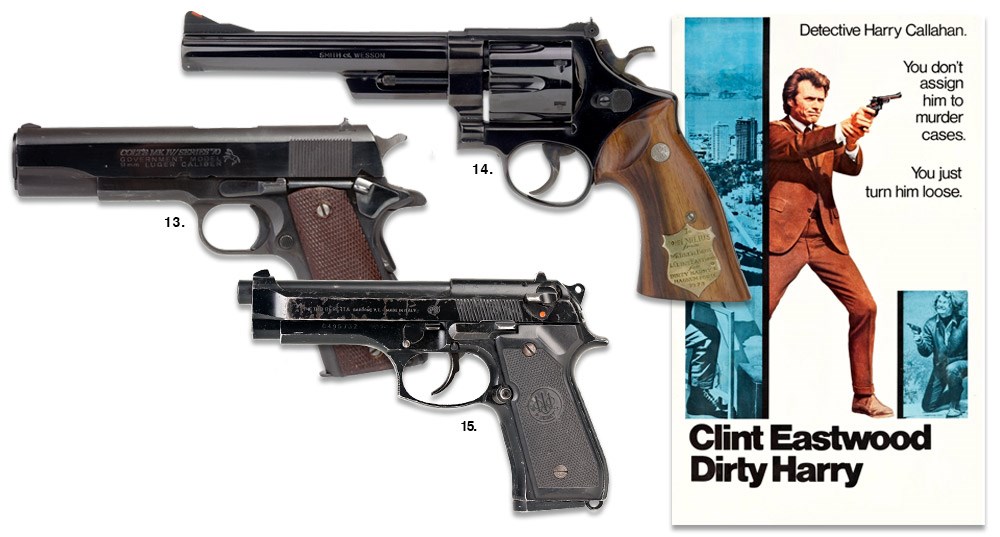
Who of a certain age could forget Tom Selleck as Thomas Magnum and 13. his Colt Mark I V/Series 70 in the T V series Magnum, P.I. (1980-1988). The actual gun is surprisingly not a .45 but a 9 mm that was adapted to fire blanks.
Perhaps the most iconic gun of any film is 14. the Smith & Wesson Model 29 in .44 Mag. carried by Clint Eastwood as Harry Callahan in Dirty Harry (1971). This handgun received notoriety as being the “most powerful handgun in the world” and prompted civilian Model 29 purchases to skyrocket.
Nearly as big of a deal was 15. the Beretta 92F S in 9 mm carried by Mel Gibson as Sgt. Martin Riggs in Lethal Weapon (1987). This Beretta was also the signature sidearm of police officer John McClane in the 1988 film Die Hard. These films sold a lot of Beretta 92s.
Though there is a lot more to be said about Hollywood studios’ uneasy love of American gun culture, we’ll leave the rest for future criticisms and applause for Hollywood and all of its offshoots.