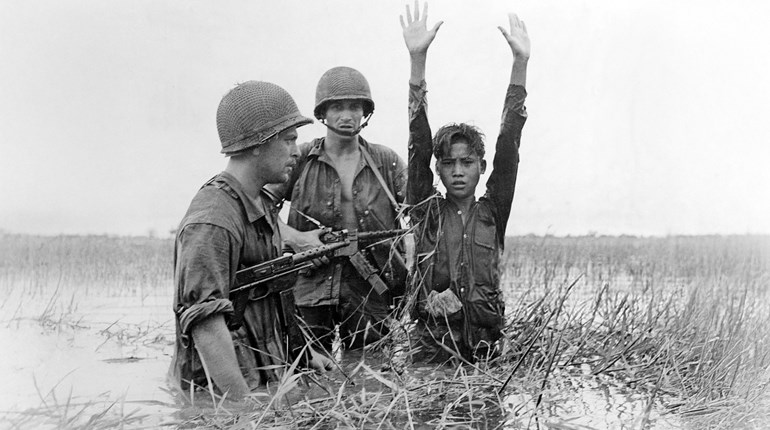
If the average American of the present era knows one thing about the Vietnam War, it is quite likely an incorrect thing: That American support of non-Communist regimes in the South in the 1950s and ‘60s was overwhelmed by a popular “people’s” revolution stemming from the undaunted but badly overmatched North.
“Jaundiced,” however, is the most courteous description that could be granted this view nowadays. As declassification at home and a partial thawing of relationships and records abroad makes clear, the Vietnam conflict was merely a change of venue for international Communist adventurism (from the stalemated Korean gambit of the early ‘50s), and nearly every government in that sphere of influence contributed something to the war against the so-called U.S. “Imperialists.” That the costs, consequences and duration were so great should have been no surprise, and likely would not have been except for a brilliant propaganda campaign contrived in Hanoi, and often forwarded by a duped and absurdly compliant Western media.
That the costs, consequences and duration were so great should have been no surprise …A second thing we’re likely to know has a greater chance of being correct: It was a conflict of very few engagements of massed men and equipment of the type familiar from the World Wars or Korea. North Vietnam had a comparatively large and well-trained military in the wake of almost a decade of war with France (1946-54), but small, irregular units known as the Viet Cong prosecuted most of the war against South Vietnam and her American allies.
November 1965 proved a notable exception. In a part of then-South Vietnam along the Cambodian border known as the Central Highlands, three People’s Army of Vietnam (PAVN, or more commonly NVA) regiments were preparing assaults on Special Forces bases in the region. October had seen a concerted effort against such a base at Plei Me. The weeklong siege of the camp was broken by South Vietnamese forces and U.S. airstrikes, but the intentions of the NVA were clear—to keep control of the Central Highlands as a staging area fed by the Ho Chi Minh Trail. From there, attacks southward toward the capital in Saigon and eastward to the South China Sea could cut the South in half.
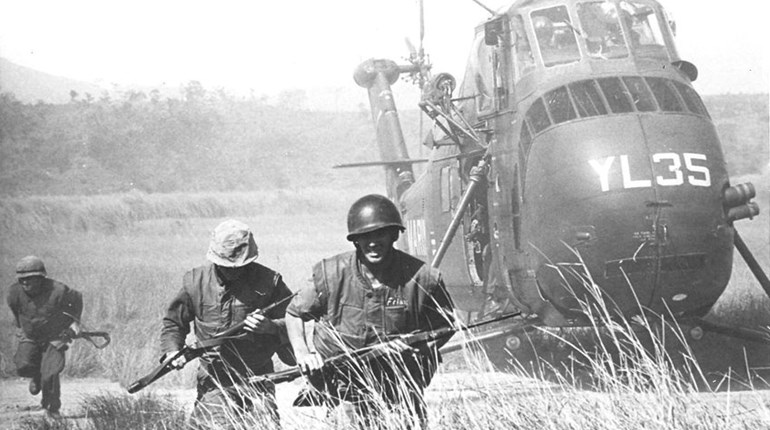
United States Army leaders thought they had a solution—air mobile troops. Poor roads in the Central Highlands had worked to the advantage of Communist forces a decade before in their war with the French; indeed, the last engagement of consequence was the almost complete loss of Groupe Mobile 100 in June 1954. U.S. commanders believed that helicopter-borne troops supported by artillery and airstrikes could attack with speed and precision that the mostly road-bound South Vietnamese forces could not emulate.
Dubbing themselves “Air Cav,” the 1st Battalion, 7th Cavalry arrived in South Vietnam in July 1965. When intelligence indicated a second attack on Plei Me was being planned and staged, Lt. Col. Harold “Hal” Moore was ordered into Ia Drang. At 10:48 a.m. on Nov. 14, 1965, Col. Moore and the first of his 450 men set down at LZ X-Ray, one of seven Moore had identified in the Ia Drang Valley.U.S. commanders believed that helicopter-borne troops supported by artillery and airstrikes could attack with speed and precision …
The next five days would see some of the most brutal fighting of the entire war. Technology was certainly on the side of the Americans: In half-hour circuits, Air Cav UH-1 “Huey” pilots delivered all of Moore’s troopers from the 1/7th, and later those of the 2/7th (under Lt. Col. Robert McDade) and of the 2/5th (under Lt. Col. Bub Tully, landing at LZ Victor) in relief. Hundreds of helicopter sorties brought ammunition and other supplies in, and air lifted the wounded out. Eventual Medal of Honor winners Captain Ed Freeman (his Distinguished Flying Cross was upgraded in 2002) and Major Bruce Crandall (his Distinguished Service Cross was upgraded in 2007) continued to do so even after the LZs were “closed.” It’s unlikely Moore and his men would have survived the first night—perhaps at all—without their heroism.
Numbers decidedly favored the NVA. Artillery and air support had cost them most of their heavy equipment, but in a tactic that was to become gruesomely familiar, they resorted to “human wave” attacks. In multiple places against sparse American lines, these were successful. On the morning of Nov. 15, Lt. Col. Moore ordered his Air Force forward air controller to transmit the code phrase “broken arrow,” which signaled their position as overrun. Air and in-range artillery support were now pre-emptively tasked to LZ X-Ray with telling effect, unfortunately including a napalm strike that erroneously hit Moore’s command post. Several soldiers were wounded and killed.
After three more days, Ia Drang resolved to a draw. American Commander General William Westmoreland and NVA Commander Colonel Nguyen Huu An both claimed success for their forces. In the short term, the North Vietnamese were thwarted in a renewed attempt on Plei Me and similar posts in the Highlands, and their casualties were ghastly. Communist forces in the region were not reconstituted until well into 1966. The U.S. Army used new tactics and performed splendidly under terrible conditions, but was unable to drive the enemy completely from the field.
The government of Vietnam simply does not know how many Communist fighters it lost …Both sides took larger lessons from the battle as well. The NVA learned to close with their adversary as rapidly as possible—only the risk of friendly fire casualties could stop increasingly precise application of both artillery and aircraft-delivered weapons. The doctrine was a successful one in the last analysis, though horrible in cost: The government of Vietnam simply does not know how many Communist fighters it lost—at least 440,000, perhaps as many as a 1.1 million.
In its turn, air mobility became a devastating hallmark of U.S. warfare. It too, came with a high price tag—a bloody, close-up and deeply sobering look at a determined adversary who they would face for the next seven and a half years.
With the maelstrom brewing at home, helicopters and astonishing heroism abroad would prove unequal to the task.
Author’s Note: The story of the Battle of Ia Drang is the complex and engrossing subject of a fine book and even rarer fine Hollywood film. We Were Soldiers Once … and Young was written by Lt. Gen. Harold Moore and UPI photographer Joe Galloway (who was present during much of the battle) and published in 1992. The movie, starring Mel Gibson and Sam Elliot, was released in 2002. We had the rare opportunity—hard to call it a “pleasure”—of seeing it for the first time with a veteran of the air war and a Vietnam-era prisoner of war, USAF Brigadier General David W. Winn. His impression of the film was indelible, and a recommendation far beyond anything we could muster: “Makes my war not seem like much.”