If variety and versatility are the measures, defensive handgunners have never had it so good. All the major parameters are well covered: Carryable/concealable dimensions and capable calibers are available in massive variety, sometimes even within the offerings of a single manufacturer (like Kimber America, for instance, here, here and here). Holsters are much the same; if you can keep track of the variety and innovation in this arena (Dale Fricke here, and especially here), congratulations: You’re doing better than we are. So as we said, it’s a good thing.
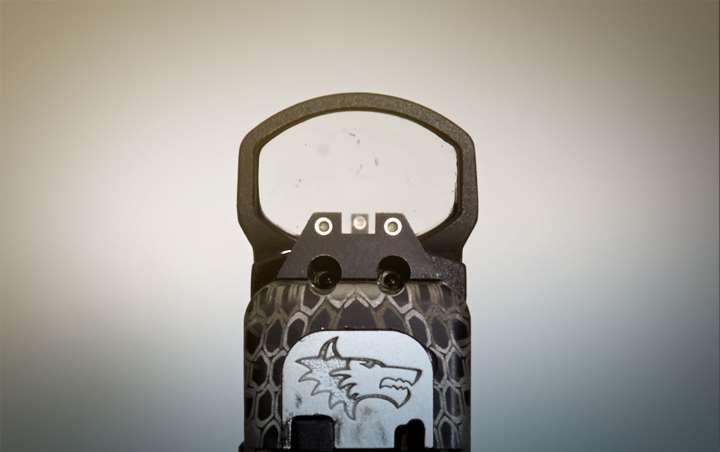
This is not to say that innovation is by any means standing still. One of the best examples of continuing movement is the integration of the modern “red-dot” sight with defensive—and particularly carry-class—handguns.
Here’s a little context if you’re unfamiliar with this technology. The mathematics of the phenomena that underpins red dots were nearly 700 years old when Sir Isaac Newton enfolded them in his 1675 Hypothesis of Light and 1704’s Opticks. What had to wait, of course, was the technology—light-emitting diodes and sufficiently-small-but-powerful batteries, mainly. From the very first example in 1900, 70-plus years elapsed before Weaver’s light-gathering Qwik Point (~1971) and the powered Swedish Aimpoint (1975) appeared.
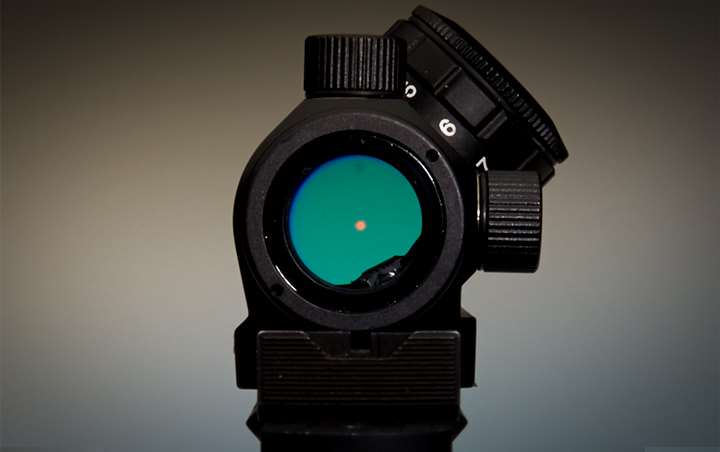
The theory is simple: A small, intense light source (usually red, hence the name) is mounted behind a spherical lens, which is partially mirrored. The reflection (a crucial point) of this light source then appears to project onto the target downrange of the firearm and shooter when viewed through the lens. Once correctly aligned with the bore, the dot appears to float on the target and—within the ballistic limits of the projectile and stance/grip/trigger press of the shooter—shows where the bullet will strike.
Big advantages accrue. First and most conceptually difficult is the alignment of the dot, the shooter’s eye and the point of impact: If the shooter can see the dot on his or her target at all, more precise alignment isn’t needed and the shot can be taken. Even at extremes of left-to-right, and/or up-and-down position of the dot on the lens, the position of the light source relative to the bore is not changed. Bore/sight alignment remains intact, and aim therefore true. Precise repeatability of head position relative to sights and target goes by the board.
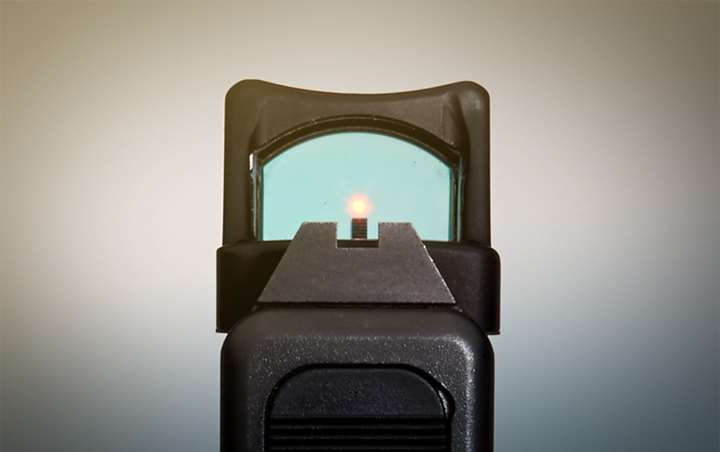
The second advantage is a biggie for older shooters: Even though that lens may actually set up at somewhere between 16 and 24 inches from the eye, the dot itself appears at optical infinity (for all practical purposes). Translation? You can use your distance-corrected eyeballs, contacts or glasses and have a clear aim point and target. Just like when we were in our … er … never mind.
The crucial byproduct you can likely calculate for yourself is speed. As is so often the case, red-dot technology was welcomed by the competitive shooting disciplines. In action-shooting forms like USPSA, they proved a game-changer: Classifier times are astonishing anyway, but red-dot sighted (and compensated) Open division guns are the acknowledged speed demons. We did a little math and chose examples that filtered out round count advantages, and still came up with a 13- to 14-percent speed edge to the dot-sighted guns.
Major adopters are also found in the military and law enforcement communities, and this should tell you something else important:
If there were battery life and durability issues anymore, we’d know. Instead, quite the opposite seems to be true. It’s hard to find a SWAT unit without red dots at least on carbines, and our SOF contacts tell us these are ubiquitous in their community, up to and including heavy machine guns.
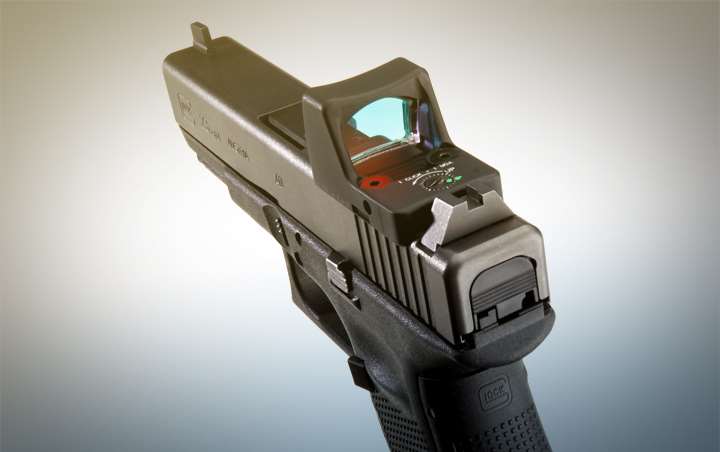
Finally, these sights are readily adaptable to modern carry-class pistols. Those who remember revolver great Bud Bond will perhaps think of this and smile (Bud routinely won Open Division and USPSA matches with an EOTech-sighted and comp’d revolver, but it was no sort of carry configuration), but companies like One Source Tactical/Suarez International and Lone Wolf Distributors have options you can add to your existing frame. Manufacturers like Glock and Smith & Wesson are not far behind with competitively oriented offerings, and it’s impossible to believe that even smaller pistols won’t soon benefit from red-dot technology.
Keep in mind that red dots aren’t magic: They won’t overcome poor or weak technique. In fact, they make some grip architecture or mechanics issues more apparent and problematic. Some shooters also find the visual “window” of these sights small (though it varies by manufacturer), but we’d argue this is a matter of practice and accommodation. And practice is always a good thing.
Perhaps the Carry Life implications are clear: While the most important consideration will always be moral—that is, no other honorable choice or action but a defensive shot remains—a red-dot-sighted defensive pistol can buy both time and precision. Even modest quantities of either can be crucial when survival hangs in the balance.
Now Carry on.
For a detailed look at some red-dot tech, take a look at NRA’s “American Warrior” analysis here.