This feature appears in the July ‘17 issue of NRA America’s 1st Freedom, one of the official journals of the National Rifle Association.
The vast majority of murders in the United States occur in just a tiny percentage of counties, and even in those counties there are large areas where there are no murders. Fact is, there is not a nationwide murder problem—and therefore we can’t expect blanket solutions to promote public safety.
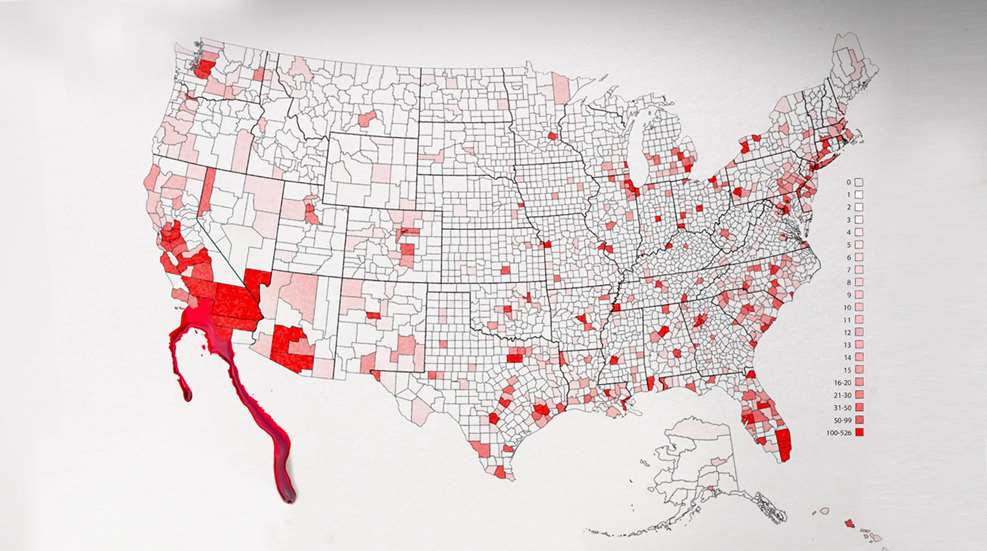
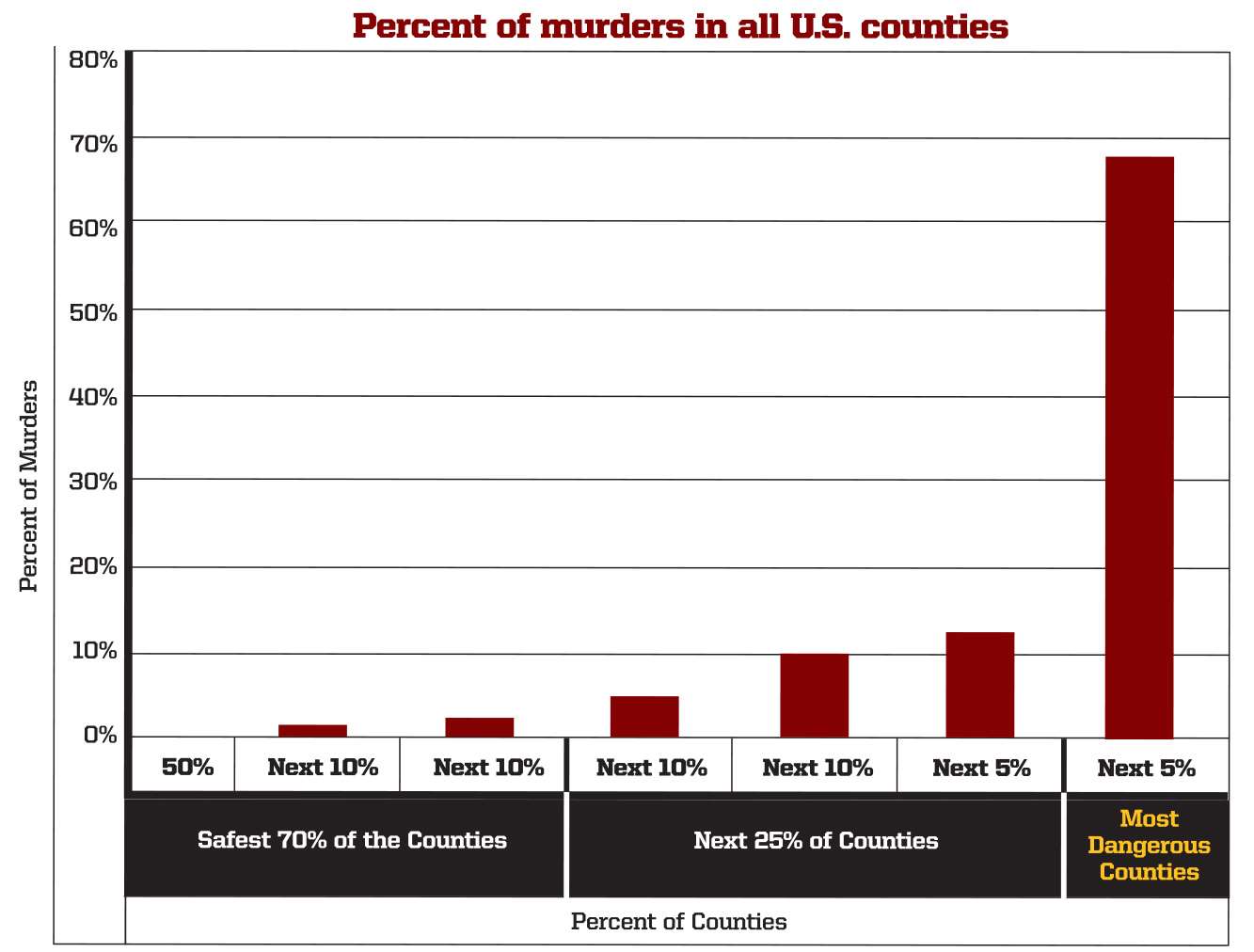
A full 68 percent of murders occurred in only 5 percent of counties.The country can actually be divided into three types of places—places where there are no murders (which make up the majority), places where there are a few murders, and a small number of places where murders are all too common.
In 2014, the most recent year that a county level breakdown is available, some 69 percent of counties have one or fewer murders, and they contain about 20 percent of the population. 54 percent of counties (containing 11 percent of the population) had no murders at all. These counties account for only 4 percent of all murders in the country.
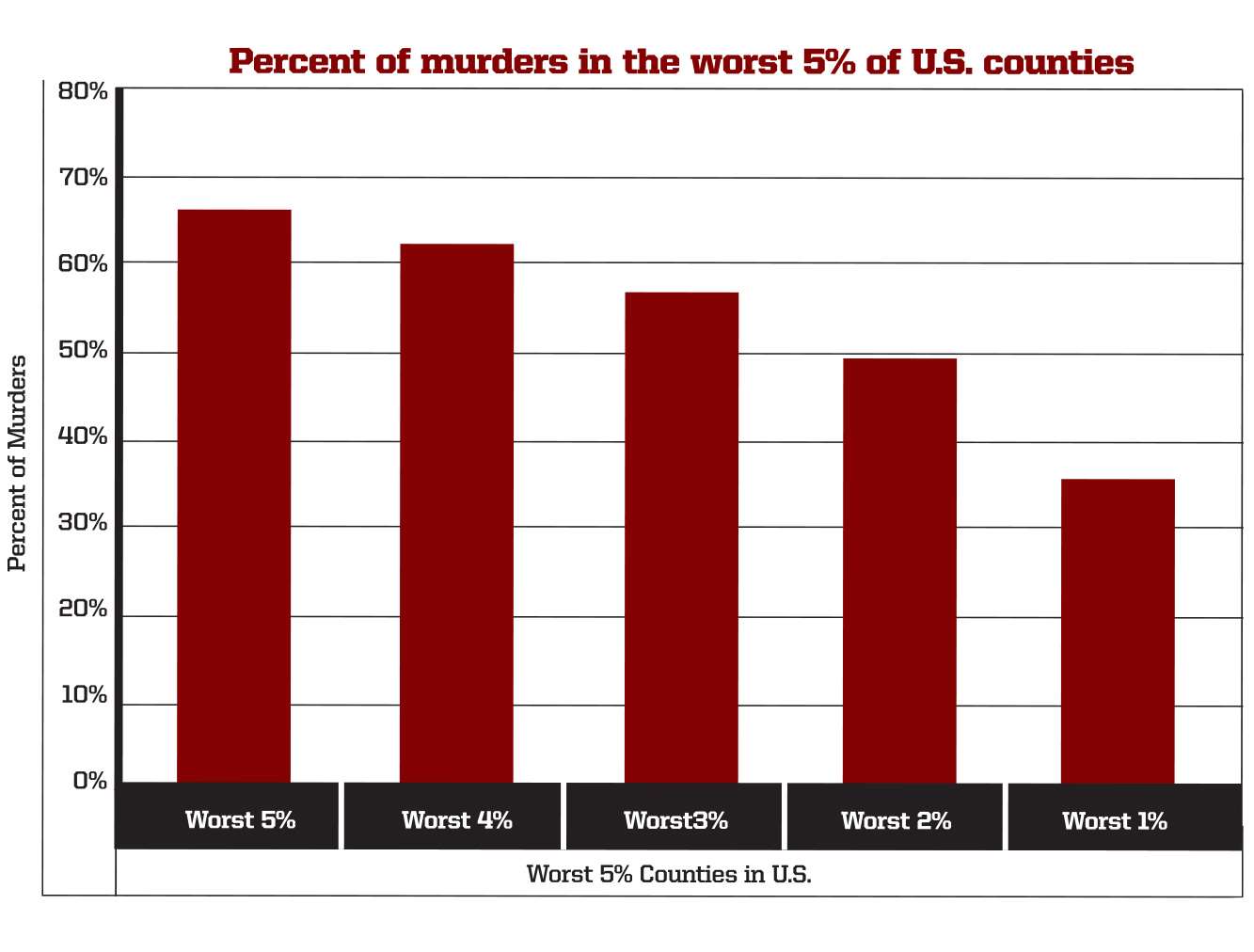
The worst 1 percent of counties have 19 percent of the population
and 37 percent of the murders. The worst 2 percent of counties contain 47 percent of the population and account for 51 percent of the murders. A full 68 percent of murders occurred in only 5 percent of counties.
Murders actually used to be even more concentrated: From 1977 to 2000, on average 73 percent of counties in any given year had zero murders. This trend is possibly a result of the opioid epidemic’s spread to more rural areas, but no one has clearly shown what has caused this change.
If the 1 percent of counties with the highest number of murders somehow were to become a separate country, the murder rate in the rest of the United States would have been only 3.4 in 2014. Removing the worst 2 percent or 5 percent would have reduced the U.S. rate to just 3.06 or 2.56 per 100,000, respectively.
Concentrations Of Murders Within Counties
When you look at individual counties with a high number of murders, you find large areas with few murders. Take Los Angeles County, with 526 murders in 2014—the most of any county in the United States in that year. There were virtually no murders in the northwestern part of the county. There was only one murder each in Beverly Hills, Hawthorne and Van Nuys. Clearly, different parts of the county face very different risks of murder.
Washington, D.C., has large areas without murders. 14th Street NW divides the eastern and western parts of the district, with murders overwhelmingly limited to the eastern half. The area around the capitol is also extremely safe.
This pattern holds true for other counties, as well.
According to a 2013 Pew Research Center survey, the household gun ownership rate in rural areas was 111 percent greater than in urban areas. Suburban households are 28.6 percent more likely to own legal guns than urban households. Despite lower gun ownership, urban areas experience much higher murder rates. One should not put much weight on this purely “cross-sectional” evidence at a single point in time, but it is hard to miss that so much of the country has both very high gun ownership rates and zero murders.
The areas where most of the murders occur are overwhelmingly areas where there are gangs—particularly drug gangs. What is clear is how useless it is to rely on gun control laws such as background checks to stop these drug gangs from getting firearms. The United States has put in massive efforts to stop illegal drugs. But just as drug gangs can bring illegal drugs into the country, they also can bring in the weapons they need to protect those valuable drugs. If one drug gang steals another gang’s drugs, it isn’t like the drug gang can go to the police and ask for help getting their drugs back. To put it another way, murder simply isn’t a “United States” problem. Murder is a problem in a very small subset of urban areas within the United States. If we are going to reduce the U.S. murder rate, we must see what is unique about those areas—and high legal gun ownership rates are clearly not a factor.Researcher and author John R. Lott, Jr. is president of the Crime Prevention Research Center. For additional information dealing with gun control and the Second Amendment, check out Lott’s newest book, The War On Guns: Arming Yourself Against Gun Control Lies. You can order The War On Guns directly from amazon.com or barnesandnoble.com.