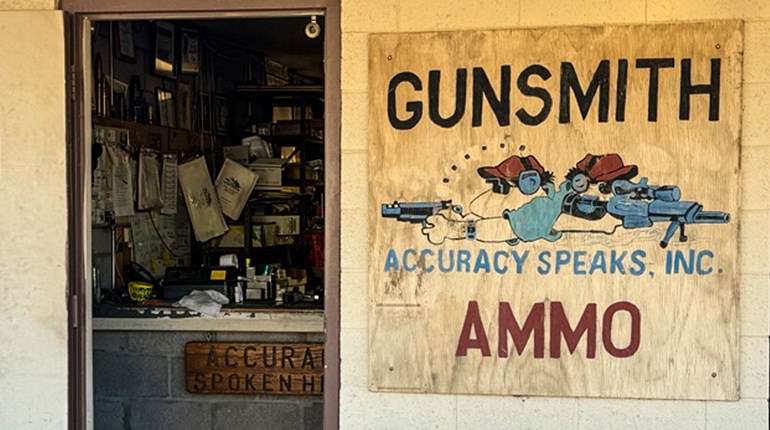
Are you a small-time gunsmith, or do you use the services of any small-time gunsmiths?
If so, you could be out of business—or out of luck in finding someone to work on your guns—as a result of President Barack Obama’s latest executive order.
Last week, just as his fellow Democrats were gathering for their convention and gun-control group grope in Philadelphia, Obama issued another one of his anti-gun executive orders. This directive could drive many, if not most, small gunsmiths in the U.S. out of business.
How?
Under Obama’s newest executive edict, many small gunsmiths who do fairly simple, unsophisticated jobs—such as threading a barrel or fabricating a small part to replace something broken in an older, out-of-production firearm—would be reclassified as “manufacturers” under the Arms Export Control Act (AECA) and International Traffic in Arms Regulations (ITAR).
And because they would now suddenly be considered “manufacturers,” these small gunsmiths would be required to register themselves as manufacturers with the U.S. State Department’s Directorate of Defense Trade Controls (DDTC)—and that registration for new applicants currently costs $2,250 per year.
For many gunsmiths, this $2,250-per-year registration fee would be prohibitively expensive—which likely means they would simply stop offering those services, and others, altogether.
Because even if they perform such work only once—and even if they never export a single firearm or firearm part—if they fail to register with ITAR as “manufacturers” and pay the exorbitant fees to do so, they could face serious criminal penalties.
And the fact is, under this new Obama directive, the gunsmithing operations that suddenly transform an ordinary gunsmith into a “manufacturer”—and thereby require $2,250-per-year registration fees—are commonplace, routine and fit no reasonable person’s definition of “manufacturing” … except the government’s.This directive could drive many, if not most, small gunsmiths in the U.S. out of business.
For example, the DDTC generally considers work that involves milling, drilling or machining an existing firearm to improve its accuracy as “manufacturing.” This would include threading a muzzle for a muzzle brake, rechambering a firearm, machining a barrel to square the tenon with the breech face, or machining a firearm as part of a blueprinting operation.
Manufacturing a gun stock, or systematically reloading ammunition through an automated process, would also require you to register with ITAR and pay the piper.
Even work as simple and routine as drilling and tapping a firearm for a scope mount—or machining a dovetail in the receiver for a scope—could be considered “manufacturing” if such work improves the accuracy of the firearm.
Yet isn’t “improving accuracy” often the point of hiring a gunsmith in the first place?
What kind of work would be exempt from the requirement that a gunsmith register as a “manufacturer” and pay the registration fee?
Well, the DDTC allows for the drop-in replacement of firearm parts, so long as they don’t need to be drilled, milled or machined to fit. But if the parts “improve the accuracy, caliber or other aspects of firearm operation,” then that may be considered “manufacturing,” requiring the gunsmith to register as a “manufacturer” and pay the aforementioned fees.
How did it come to this? Some background is in order here.
The Arms Export Control Act (AECA) and ITAR govern how military materiel is exported from, and imported into, the United States.
If this all sounds hopelessly confusing, contradictory and filled with statutory booby-traps laid for the unsuspecting shade-tree gunsmith—maybe that’s the point.Items subject to these import/export controls are described on the government’s so-called “U.S. Munitions List.” And although the listed items are called “defense articles,” they are not limited to military firearms and their parts, or even “military-style” firearms—to quote Hillary Clinton—and their parts.
In fact, the U.S. Munitions List generally includes not only every firearm of .50 caliber or smaller, but also parts for those firearms—parts as mundane as a spring, a trigger guard or a magazine floorplate.
What’s more, as the NRA Institute for Legislative Action points out in a detailed analysis, the Gun Control Act of 1968 and its amendments over the years also regulate firearm manufacturing, import and export, and use some of the same or similar terms—“gunsmithing,” “manufacturing,” “engaged in the business” and so on—but those terms have different meanings, and are applied in different ways.
If this all sounds hopelessly confusing, contradictory and filled with statutory booby-traps laid for the unsuspecting shade-tree gunsmith—maybe that’s the point.
The strategy behind many of the countless and seemingly pointless local, state, federal and international anti-gun laws on the books—tens of thousands of them—is to put gun owners in fear; to plant a seed of doubt and uncertainty over whether they’re violating some unknown and unknowable law; and to thereby make gun owners throw up their hands in frustration and perplexity and give up owning a gun at all.
It’s a piecemeal strategy based on banning this gun, or that ammunition, in this particular place, or for that particular reason; prohibiting ever-wider classes of persons from lawfully owning a gun; attacking the manufacturers or dealers or customizers or repairers of firearms; and chipping away at every edge until nothing is left in the middle—and no one is left who cares enough to defend it.
It might be just another one of Obama’s executive orders—but it’s a strategy Hillary Clinton has vowed to continue as commander-in-chief.
The only way gun owners can prevent that endgame is by defeating Clinton on Election Day this November.